Artificial Intelligence is definitely no longer a novelty. After all, it’s in our phones, in customer service systems, in product suggestions. But for many companies, there is still a gap: how to make AI “think with your data”? This is where personalized AI agents come into play.
They emerge precisely to fill this gap. That’s because, instead of relying exclusively on generic models trained with public data, these agents learn the context of your organization to provide answers, insights, and recommendations that standard models cannot deliver.
And the market shows the size of the opportunity: the global AI agents sector is expected to move USD 7.63 billion in 2025 and reach USD 50.31 billion by 2030, with an average annual growth of 45.8%. In other words, it is no longer a distant trend: it is a movement in full acceleration.

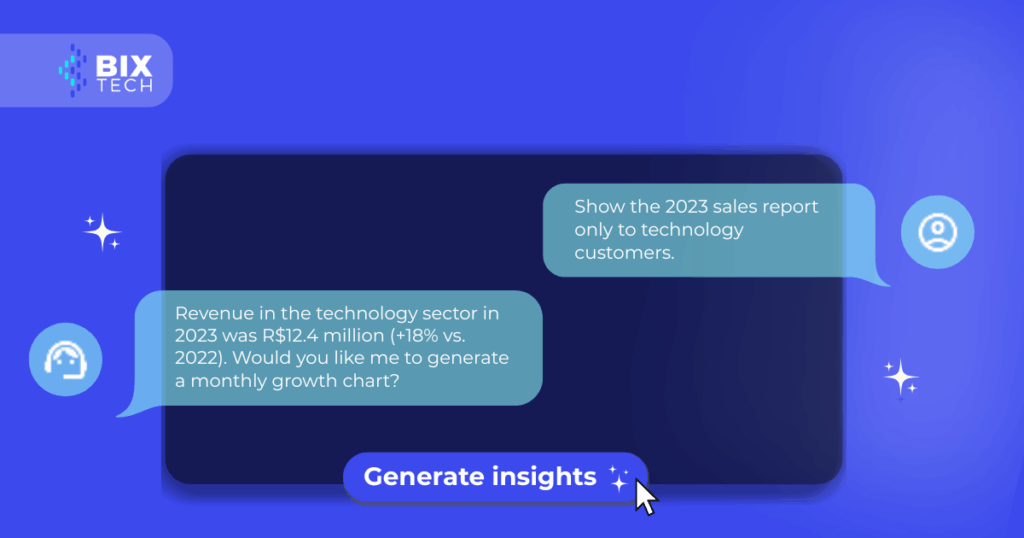
In this article, you will understand what personalized AI agents are, how they work, their main benefits, and more. Keep reading!
What are personalized AI agents?
Personalized AI agents are Artificial Intelligence systems that understand the context of your company to generate tailored answers, analyses, and recommendations.
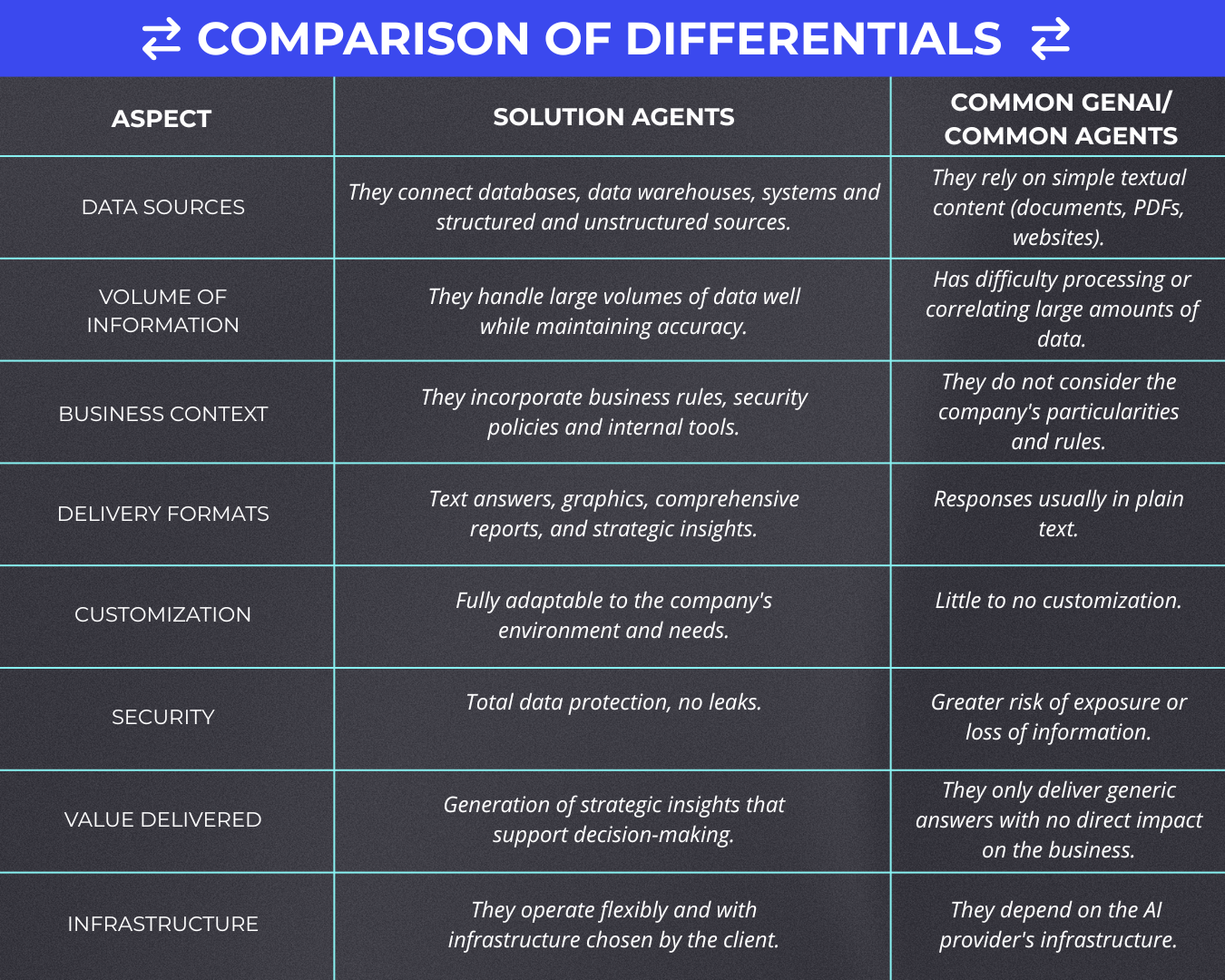
They don’t just “chat” with documents: they also connect to different data sources, whether internal or external, to deliver relevant insights. Once business rules, security policies, and strategic information are incorporated, these agents offer results that are truly applicable to day-to-day operations.
The differentiator: far beyond documents
Most current AI solutions were designed to handle unstructured data such as texts, PDFs, or web pages. This works well in some scenarios but becomes limited when a company needs to work with structured data at scale.
This is where personalized agents stand out: they connect to databases, Data Warehouses, and corporate systems, cross-checking thousands of rows in seconds and generating analyses that generic AI chatbots simply cannot deliver with the same precision.
How do personalized AI agents work?
To deliver greater accuracy in responses, personalized AI agents follow a flow that goes beyond a simple document lookup. They analyze your company’s context (business rules, security policies, integrations, and tools already in use) to select the right information.
The process happens in four main steps:
- Question: the user makes a request in natural language, such as “What were the best-selling products in the last quarter?”.
- Queries: the agent translates this request into specific queries for each data source, whether a relational database, a Data Warehouse, or a spreadsheet.
- Search and reflection: the information returns and is processed by the model, which cross-references different origins, identifies patterns, and eliminates redundancies.
- Response: the result is delivered in the most useful format for the business, whether text, charts, complete reports, or even strategic recommendations.
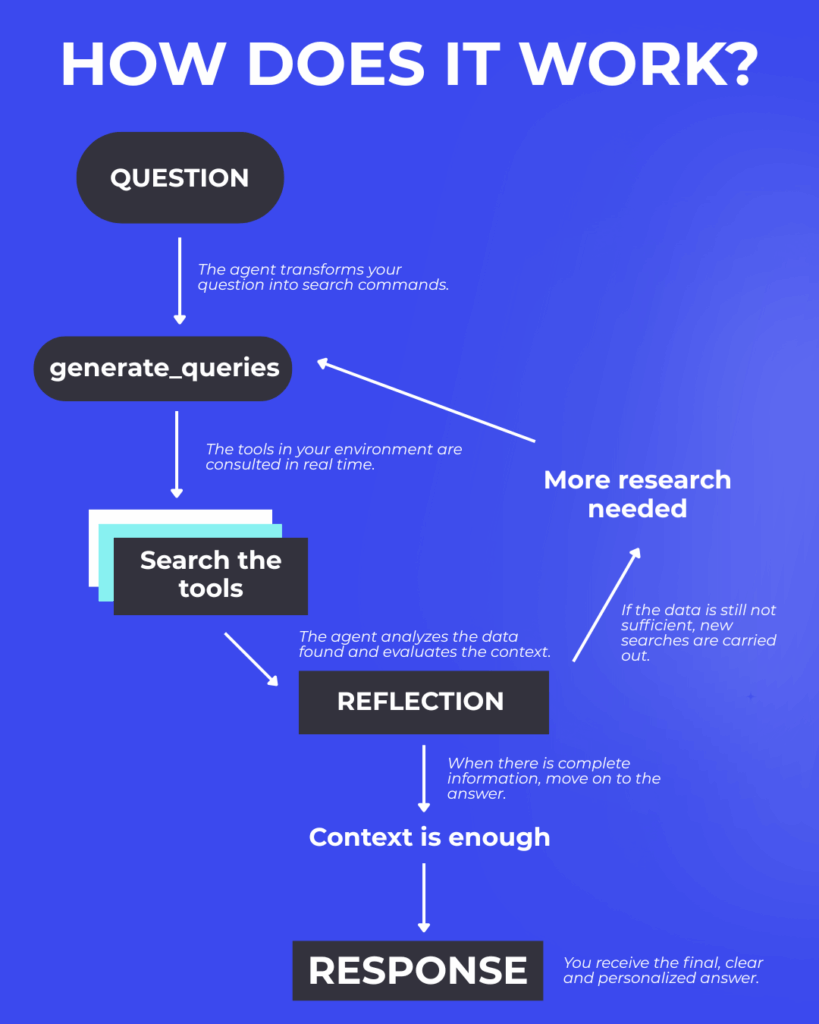
This cycle allows the agent to go beyond the “memory” of a generic model. It adapts to the organization’s context and returns responses aligned with its decision-making needs. And it also goes beyond just responding.
Agents can also perform actions based on the information they process, a step ahead of conventional AIs. For example: if you ask a generic AI “what is the return policy for most e-commerces?”, it will answer because it was trained on a public dataset. But if you ask “what is the return policy of my e-commerce?”, it will not know, unless it has access to your knowledge base.
Now imagine going beyond that: after answering, the agent asks, “Do you want to return the product?”. From there, the reverse logistics process begins. At this point, it is no longer just a language model, it begins to act autonomously, interacting with systems and connecting data with real action.
Benefits of personalized AI agents
Implementing a personalized AI agent goes far beyond just automating responses: it’s about transforming the company’s relationship with its data. Every decision becomes guided by information that is more complete, reliable, and easy to access.
In practice, the gains are evident:
Less searching, more action. Instead of wasting time looking for scattered data, your team receives ready-made answers, in the right format, at the right moment.
Security first. Agents operate within your own environment, respecting access rules and existing security policies, with no risk of data leakage.
Tailored insights. Since they cross internal sources, personalized AI agents understand the nuances of your organization and deliver contextualized recommendations that make sense for your reality.
Scalability and flexibility. You decide where the agent runs, whether in the cloud, on-premises, or in a hybrid environment, and it scales with your technological infrastructure.
From response to action. In addition to interpreting information, agents can also execute tasks: from generating reports to initiating automated workflows, all within your company’s rules and systems.
Personalized AI agents in practice
To better understand the power of personalized AI agents, here’s an example.
Imagine that your company’s sales team decides to analyze the results of the year 2024. In a normal context, this would involve extensive spreadsheets, manual data cross-checking, and hours of meetings to identify trends, right?
Now imagine you want to ask the following question: “What was the revenue variation by region compared to 2023?”
If you asked this question to a generic AI, like ChatGPT or Gemini, it might understand the context. However, it would not be able to directly access your company’s real data. A personalized AI agent, on the other hand, was created precisely for that: it connects to databases, Data Warehouses, and internal systems, executes queries in real time, and returns answers based on updated and secure information.
The result may come in the form of a comparative chart, performance report, or recommendation list such as “invest more in the South region” or “adjust pricing in the Midwest”. No formulas, macros, or complex dashboards, just information ready for decision-making.
And if the agent identifies an anomaly in performance, it can not only notify the team but also trigger an automatic review task in the CRM.
However, it’s important to emphasize that this type of automation does not eliminate human judgment. On the contrary: it frees up time for teams to think about what truly matters — that is, the next actions.

Why adopt this technology now?
The use of personalized AI agents represents a turning point in how organizations access and interpret their own data. If before Artificial Intelligence was seen only as an automation tool, now it goes beyond that: it becomes a strategic asset capable of supporting business decisions in real time.
While generic models still depend on public information, personalized agents turn what already exists within your organization into insights. And in an increasingly competitive market, those who first learn to use their own data as a competitive advantage get ahead.
More than following a trend, investing in personalized AI agents is about building long-term efficiency and intelligence. Companies that combine intelligence with action on their own data will pull ahead, reducing the time between insight and execution.
Start turning your data into intelligence
At BIX Tech, we develop personalized AI agents capable of understanding, responding, and acting based on your company’s data, connecting insights to concrete results.
Our goal is simple: to make AI work in favor of your decisions, eliminating manual tasks, reducing noise, and accelerating results.
Get in touch with our team and see in practice how a personalized AI agent can bring tailored insights to your organization!
Frequently Asked Questions (FAQ)
1. What makes a personalized AI agent different from tools like ChatGPT or Gemini?
Generic AI models are trained on public data and provide broad answers. A personalized AI agent connects directly to your company’s internal data, understands business rules and security policies, and delivers responses and actions tailored to your reality.
2. Is it safe to use AI agents that access internal company data?
Yes. Personalized agents run within your own environment, whether cloud, on-premises or hybrid, following existing access permissions and security policies. No sensitive information needs to leave your infrastructure.
3. Do I need to have all my data fully organized before implementing an AI agent?
Not always. You can start with specific data sources such as spreadsheets, databases or existing systems, and expand gradually as your data structure evolves.
4. Do these agents replace human teams?
No. They do not make decisions on their own. They automate data access and analysis so your team can focus on deciding and acting based on reliable information.
5. Which departments can benefit the most?
Sales, marketing, finance, supply chain, HR, operations and even customer support can use personalized agents to get instant answers, generate automatic reports or trigger operational workflows.
6. How long does it take to deploy an AI agent?
It depends on the complexity of the integrations. Simple projects connected to structured data sources can go live within a few weeks.
7. Can the agent perform actions or does it only answer questions?
It can do both. Besides responding, it can trigger workflows, send alerts, update records in CRM or ERP systems or open support tickets, as long as those actions are authorized.
8. Does my team need training to use it?
In most cases, no. Interaction happens through natural language, just like chatting. Asking something like “What was the revenue variation by region last year?” is enough to receive actionable insights.
9. How do I get started?
Begin by choosing a clear use case and a reliable data source. For example, speeding up sales reporting or automating financial analysis. From there, the agent can be configured and improved over time.
Next steps
The journey with Snowflake is transformative, and our team is here to guide every step. Whether you’re looking to optimize costs, accelerate innovation, or ensure robust data governance, we’re ready to help. Contact us today to discover how we can propel your data strategy forward and turn your challenges into impactful opportunities.