Data Mining: How intelligent automation redefines enterprise information processing

Modern businesses deal with a growing volume of documents every day: contracts, invoices, spreadsheets, receipts, forms, and reports. The challenge isn’t just storing this data, but also extract relevant information accurately, safely and quicklyThis is the role of data extraction, a process that has become strategic in the era of artificial intelligence applied to business.

Data extraction consists of automatically identify, capture and structure information contained in different types of documents, whether digital, digitized, or even images. The goal is to convert unstructured data into intelligible content for analytics systems, ERPs, or CRMs, eliminating manual data entry and drastically reducing the risk of human error.

The technological turn of automation

With advances in artificial intelligence, the extraction process no longer relies on fixed rules or static templates. Platforms based on machine learning and natural language processing (NLP)are now able to interpret the semantic context of a document. This means that the system not only recognizes words or numbers, but also understands their function within the content: a financial amount, an expiration date, a company name, or a contractual clause.

This contextual capability completely transforms productivity. A finance department that previously took hours to register invoices can now process thousands of files in minutes, with near 99% accuracy. Similarly, legal teams can automate contract screening, extracting sensitive clauses, deadlines, or signatures, optimizing analytical work and reducing compliance risks.
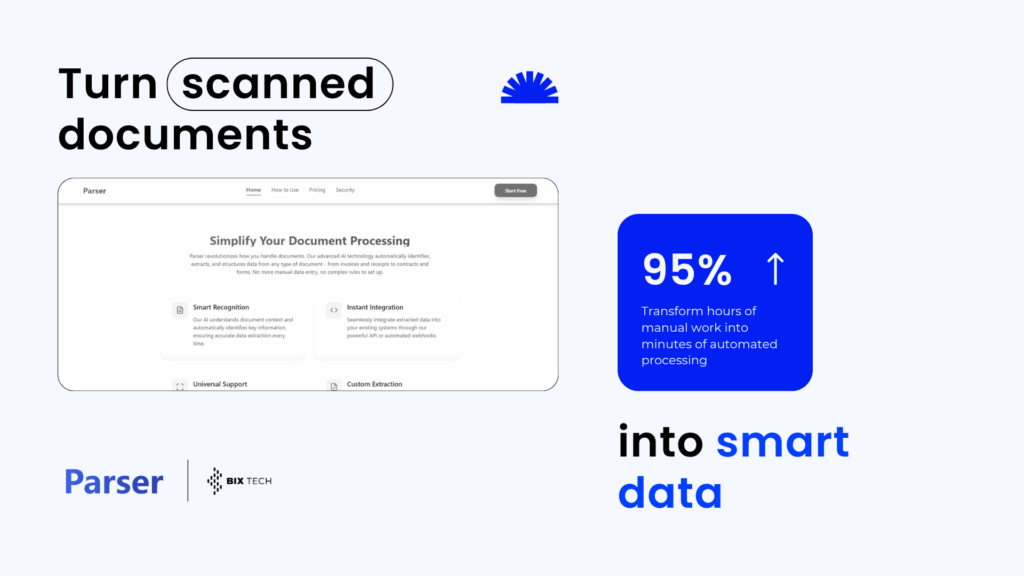
Parser: AI applied to corporate data extraction

Parser, developed byBIX, represents one of the most advanced solutions on the market for automated extraction of corporate data. Designed for large-scale operation, Parser uses AI algorithms capable of understanding different document formats and patterns, offering instant integration with enterprise systems and customizable configuration of fields and extraction rules.

Among the main technical differences of Parser are:

  • Universal format processing– Full support for PDFs (including scans), JPG, PNG, and TIFF images, Excel and CSV spreadsheets, Word documents, JSON, and XML.
    • RESTful API and real-time webhooks– Direct integration with corporate applications, allowing continuous data flow without the need for manual intervention.
    • Custom extraction– The user defines the fields of interest, and the AI ​​progressively learns to optimize accuracy.
    • Smart validation– Automatic consistency and compliance checking, ensuring quality and reliability in the captured information.
    • Corporate security and privacy– Processed documents are deleted within seven days, and no information is used to train the model.

With this architecture, Parser enables applications in diverse sectors, such as finance, legal, logistics, human resources, and administration.

Practical applications

  • Invoice processing: automatic extraction of values, CNPJs, dates and service descriptions, reducing up to 95% of the time spent on checking and launching.
  • Contract analysis: identification of involved parties, critical clauses and due dates, allowing average savings of 85% in document review tasks.
  • Refund and receipt management: capture of values, taxes and expense categories, automating daily financial reports.
  • Smart scanning: conversion of physical files into structured databases, reducing storage costs by up to 90%.
  • Form processing: extraction of responses and registration fields in bulk, speeding up HR processes and public records.

Integration-oriented architecture

Parser was designed with a focus on interoperability. Through modern APIs, extracted data can be sent directly to corporate systems in JSON, CSV, or XML format.configurable webhooks allow real-time updating of databases, ensuring immediate synchronization between platforms.

This structure allows Parser to function as an intelligence layer attached to the existing infrastructure, without the need to rebuild systems.

Security and compliance

In a scenario regulated by legislation such as LGPD, the responsible handling of sensitive information is essential. Parser adopts strict security practices, including end-to-end encryption, automatic deletion of files after seven days and full control of access to processed data

Furthermore, the solution does not use any customer documents to train AI models, ensuring total privacy.

FAQ – Frequently Asked Questions about Data Extraction and Parser

What exactly is automated data extraction?
It is the process of using artificial intelligence algorithms to identify and extract structured information from unstructured documents, such as PDFs, images, and forms.

Does the Parser require complex initial setup?
No. The platform’s setup process takes about five minutes. Simply upload a batch of documents and the system will automatically learn the extraction patterns.

What document types does the Parser support?
The Parser supports PDFs, DOCX files, Excel and CSV spreadsheets, images in various formats, and even structured data in JSON or XML.

How is integration with other systems done?
Through a RESTful API and real-time webhooks, Parser sends the extracted data directly to ERPs, CRMs, or corporate databases.

Is the submitted data used to train the AI?
No. Parser guarantees complete confidentiality. No processed documents are used for training.

How long are documents stored?
Files are automatically deleted from the system after seven days, ensuring compliance with security and privacy standards.

Is it possible to customize the type of data extracted?
Yes. Parser allows you to define custom templates and specific extraction rules, adapting to different sectors and document types.

What is the average productivity gain?
Companies using Parser report reductions of up to 95% in processing time and significant operational savings, as well as increased data reliability.

And now?

By this point in the text, you should have understood that theAutomated data extraction is more than a technological trend: it’s an essential step in the digital maturity of organizations. Solutions like Parser demonstrate that the combination of artificial intelligence, real-time integration and data security creates a more agile, accurate and scalable information ecosystem.

Companies that invest in extraction automation not only gain efficiency but also build a solid foundation for data-driven strategic decisions.

Try Parser for free and see how it is possible to automate in minutes what previously required hours of manual work.


Don't miss any of our content

Sign up for our BIX News

Our Social Media

Most Popular

Start your tech project risk-free

AI, Data & Dev teams aligned with your time zone – get a free consultation and pay $0 if you're not satisfied with the first sprint.