
Modern web applications live in a hostile environment. Automated bots probe for weaknesses 24/7, credential stuffing attacks target login pages, and API endpoints are routinely tested for injection and abuse. As traffic scales-especially across multiple regions, microservices, and third-party integrations-so does the attack surface.

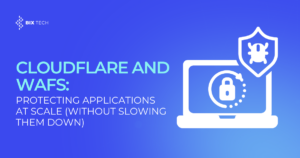
That’s where a Web Application Firewall (WAF) becomes essential. And when paired with a globally distributed edge network like Cloudflare, a WAF can help protect applications at scale, reducing risk while keeping performance strong.
This guide breaks down what Cloudflare’s WAF does, how WAFs work in general, and how to implement practical protection patterns for real-world web apps and APIs.
What Is a WAF (Web Application Firewall)?
A WAF is a security layer that sits in front of a web application and filters, monitors, and blocks malicious HTTP/S traffic. Unlike traditional network firewalls (which focus on ports and protocols), a WAF understands web traffic patterns and inspects requests at the application layer.
What a WAF typically protects against
A well-configured WAF helps mitigate many common threats, including:
- SQL injection (SQLi)
- Cross-site scripting (XSS)
- Cross-site request forgery (CSRF) patterns
- Remote file inclusion (RFI) / local file inclusion (LFI)
- Known CVEs and exploit attempts
- Bad bots and automated abuse
- Credential stuffing signals (often when combined with bot mitigation and rate limits)
Many WAF strategies align closely with the OWASP Top 10 categories (a widely used industry reference for the most common web application security risks).
Why Cloudflare for WAF at Scale?
A WAF is only as effective as its ability to:
- See traffic early
- React fast
- Handle high volume
- Avoid excessive false positives
- Remain manageable over time
Cloudflare’s strength is that it operates at the edge-meaning requests can be inspected and blocked before they ever reach your origin infrastructure. This is especially valuable when you’re dealing with:
- Global traffic spikes
- High-frequency bot traffic
- DDoS attempts blended with “normal-looking” HTTP requests
- API abuse that can drive cloud bills up quickly
In a scaling environment, protection has to be repeatable, automated, and performance-aware. Edge-based enforcement is a major advantage.
Key Cloudflare WAF Capabilities (In Practical Terms)
Cloudflare’s application security toolkit is typically implemented as a combination of WAF policies, managed rules, custom rules, rate limiting, and bot controls.
1) Managed WAF rules (fast baseline coverage)
Managed rulesets help cover known attack patterns without requiring you to handcraft every signature. They’re useful for quickly reducing exposure to common exploitation techniques across many applications.
Best use case: organizations that want strong default protection, plus the option to tune over time.
2) Custom WAF rules (precision for your app)
Custom rules let you express intent like:
- Block requests to
/wp-login.phpwhen you don’t run WordPress - Challenge traffic to
/api/auth/*coming from suspicious ASNs - Allowlist partner IP ranges for sensitive admin paths
- Enforce header presence or expected methods (e.g., only
POSTto/login)
Best use case: reducing false positives and protecting app-specific endpoints.
3) Rate limiting (stopping abuse before it becomes downtime)
Rate limiting protects endpoints that attackers love to hammer:
- Login endpoints (
/login,/signin,/oauth/token) - Search endpoints (expensive queries)
- Checkout/payment routes
- Public APIs (especially if they’re not tightly authenticated)
Best practice: apply different thresholds per endpoint, not a single global limit. A login route behaves differently than a product listing route, and your protections should reflect that.
4) Bot management and challenges (separating humans from automation)
Many “application attacks” aren’t sophisticated-they’re simply relentless automation. Cloudflare’s bot capabilities help distinguish:
- Good bots (search engine crawlers)
- Suspicious bots (scrapers, scanners)
- High-risk automation (credential stuffing, inventory scalping)
Common mitigation: challenge or block bot-like traffic on high-value endpoints while allowing normal browsing.
5) DDoS protection + WAF (layered defense)
DDoS events often overlap layers. You may see:
- Volumetric traffic floods (network layer)
- HTTP floods that look like real browsing (application layer)
- API floods designed to exhaust resources
Cloudflare’s edge network can absorb and mitigate many of these patterns while your WAF rules handle application-specific abuse. For a deeper look at building real-time systems that stay resilient under load and abuse, see event-driven architecture patterns for real-time systems.
WAF Deployment Models: Where Cloudflare Fits
WAFs generally show up in a few common architectures:
Reverse proxy / CDN-edge WAF (Cloudflare’s model)
Traffic flows through the provider before reaching your origin.
Advantages:
- Blocks attacks earlier (before hitting your servers)
- Reduces origin load and bandwidth costs
- Globally distributed enforcement
Host-based or in-cluster WAF
Runs inside your infrastructure (e.g., with Kubernetes ingress controllers or service meshes).
Advantages:
- Deeper integration with internal routing
- Useful for east-west traffic controls
Tradeoff: it can consume your own compute and scaling capacity-exactly what you don’t want during a traffic surge.
For high-scale public-facing apps, the edge-based approach is typically preferred because it reduces pressure on origin systems.
Practical WAF Strategies That Work at Scale
The goal isn’t “block everything.” It’s to reduce risk while keeping legitimate users flowing. Here are patterns that scale well across multiple apps and teams.
1) Start with managed rules, then tune using real traffic signals
A sustainable approach looks like this:
- Enable managed rules in a monitoring mode (where possible)
- Review false positives and noisy rules
- Add exceptions for known-good patterns (specific paths, parameters, or user agents)
- Promote to blocking mode once stable
This prevents the classic problem: enabling a WAF aggressively and accidentally blocking customers.
2) Protect your highest-risk endpoints first
Not all routes are equal. Prioritize protections around:
- Authentication endpoints
- Admin panels
- File upload endpoints
- Public APIs
- Checkout/payment flows
If your team is short on time, securing these routes yields the highest ROI.
3) Use “allow” rules thoughtfully (and sparingly)
Allowlisting can reduce friction for:
- Internal admin access via corporate IP ranges
- Trusted third-party services (payment providers, webhook senders)
- Monitoring tools
But avoid broad allowlists that bypass meaningful inspection across large traffic segments.
4) Build a layered model: WAF + rate limiting + bot controls
At scale, a single control is rarely enough.
- WAF blocks exploit patterns
- Rate limiting reduces brute-force and endpoint abuse
- Bot controls stop automation that doesn’t look like “classic attacks”
- Access policies restrict sensitive surfaces (admin, staging, internal tools)
Layered security is how you stay resilient when attackers change tactics. To operationalize this approach, it helps to align on metrics, logs, and traces for a unified observability view.
5) Treat APIs as first-class attack surfaces
APIs are often easier to attack than UI pages because they’re predictable and high value. For API protection:
- Enforce method correctness (e.g.,
GETvsPOST) - Rate limit per token, IP, or route
- Block known-bad patterns in parameters
- Consider schema validation upstream (WAF complements this, but doesn’t replace it)
Common Pitfalls (And How to Avoid Them)
Pitfall 1: Assuming the WAF replaces secure coding
A WAF is a protective layer, not a substitute for:
- Input validation
- Parameterized queries
- Proper authentication and authorization
- Secure session management
Use the WAF to reduce exposure and buy time, but continue fixing root causes.
Pitfall 2: Overblocking with generic rules
If your WAF blocks too much, teams will disable it. The fix is to:
- Start with sensible defaults
- Use analytics/logs to tune
- Apply stricter rules only where needed (login, admin, API auth)
Pitfall 3: One-size-fits-all policies across many apps
A portfolio of applications requires a portfolio of controls. Standardize what you can (baseline managed rules), then customize where the app demands it (custom rules on sensitive routes).
Cloudflare WAF vs. Traditional WAF: What’s Different?
Traditional WAF deployments are often:
- Hardware appliances
- Regional virtual appliances
- In-datacenter reverse proxies
Those can work well, but at large scale they can become operationally heavy and slower to adapt.
Cloudflare’s edge model is typically chosen for:
- Faster time to protection
- Easier scaling for global traffic
- Centralized rule management
- Reduced origin load under attack
Featured Snippet FAQ: Cloudflare WAF and Application Security
What does a WAF do?
A WAF (Web Application Firewall) inspects HTTP/S requests and blocks malicious traffic such as SQL injection, XSS, exploit attempts, and abusive bots before they reach a web application.
Is Cloudflare a WAF?
Cloudflare provides WAF capabilities as part of its application security services. It can apply managed and custom rules at the edge to detect and mitigate common web attacks and abusive traffic patterns.
Does a WAF stop DDoS attacks?
A WAF can help mitigate some application-layer DDoS attacks (like HTTP floods), especially when combined with rate limiting and bot controls. Volumetric DDoS protection typically requires additional network-layer defenses, which Cloudflare also provides at the edge.
Can a WAF protect APIs?
Yes. A WAF can protect APIs by filtering malicious requests, blocking suspicious payloads, enforcing rate limits, and stopping automation that targets predictable API endpoints. For best results, WAF protection should be paired with strong authentication and authorization.
Will a WAF slow down my website?
A well-implemented edge WAF is designed to minimize latency by filtering traffic close to the user and blocking malicious requests before they reach the origin. Performance impact is typically far lower than the cost of processing malicious traffic at the application layer.
Final Thoughts: Protecting Applications at Scale Is a System, Not a Setting
Cloudflare and WAFs are most effective when treated as part of a broader application security strategy-one that blends baseline managed protections with targeted custom rules, rate limiting, and bot mitigation. At scale, the goal is consistency and resilience: reduce risk, keep performance strong, and make security manageable as applications evolve.
A WAF won’t fix insecure code, but it can dramatically reduce exposure, absorb abusive traffic, and help teams ship faster with fewer security regressions-especially when your applications and APIs are growing across regions, users, and complexity. For teams building security into modern platforms, it’s also worth understanding ECS vs Kubernetes tradeoffs for container platforms.