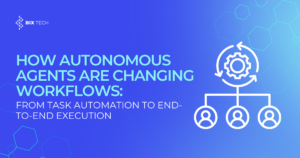

Autonomous agents are quickly moving from “interesting AI demos” to practical tools that reshape how modern teams get work done. Unlike traditional automation-where workflows follow rigid, predefined rules-autonomous agents can plan, decide, and act across multiple steps, adapting as conditions change. The result is a new kind of workflow: less about handoffs and checklists, and more about outcomes.

This shift is already visible across operations, customer support, software engineering, finance, and marketing-anywhere work involves repetitive coordination, document handling, decision-making, or back-and-forth between tools. And as agentic AI matures, companies are redesigning processes around continuous execution rather than isolated tasks.
What Are Autonomous Agents (and How Are They Different from Chatbots)?
An autonomous agent is an AI system that can pursue a goal with minimal supervision by:
- Interpreting objectives (e.g., “reduce onboarding time” or “resolve these support tickets”)
- Planning steps to complete the work
- Using tools (APIs, CRMs, spreadsheets, internal knowledge bases, ticketing systems)
- Taking action (creating records, drafting messages, triggering workflows, updating dashboards)
- Checking results and iterating when outcomes don’t match expectations
Chatbots vs. autonomous agents
A chatbot typically responds to prompts in a conversational loop. An autonomous agent goes further: it can operate a workflow, coordinating multiple systems and steps to complete a job.
Think of it like the difference between:
- A helpful assistant who answers questions, and
- A project coordinator who executes tasks, follows up, and closes the loop.
Why Autonomous Agents Are Changing Workflows Now
Several trends are converging to make agentic workflows feasible:
1) Tools are increasingly API-first
Most business systems-CRMs, ERPs, customer support platforms, analytics tools-are accessible programmatically. Agents can be connected to these systems to create and update data instead of only generating text.
2) Work has become more cross-functional
Modern work is often a chain of micro-actions: research → draft → review → update tools → notify stakeholders. Agents are well suited to this “workflow glue” work.
3) AI can now handle unstructured inputs
Many workflows break because they depend on messy inputs: emails, PDFs, call transcripts, screenshots, forms, and scattered notes. Agents can interpret these reliably enough to drive processes forward.
4) Teams are under pressure to do more with less
The strongest use cases aren’t about replacing people; they’re about reducing low-leverage effort-copy/paste tasks, routine follow-ups, triage queues, internal routing, and repetitive documentation.
The Workflow Shift: From Automation Scripts to Agentic Execution
Traditional automation generally looks like this:
- If X happens → do Y
- If a field is missing → stop or escalate
- If the process changes → rewrite the logic
Agentic workflows look different:
- Understand the goal → create a plan
- If data is missing → find it (or ask for it)
- If there’s a blocker → propose options or escalate
- If the process changes → adapt without a full rebuild
This is a major evolution: instead of automating steps, organizations start automating outcomes-while keeping humans in the loop where judgment matters.
Real-World Examples of Autonomous Agents in Workflows
Below are practical examples where autonomous agents are already changing day-to-day operations.
1) Customer Support: From ticket response to resolution orchestration
Autonomous agents can:
- Triage incoming tickets by intent, severity, and account value
- Retrieve relevant knowledge-base articles and prior cases
- Draft responses aligned with company policy and tone
- Trigger actions (refund workflows, replacements, password resets, cancellations)
- Escalate only when needed, with a complete summary and evidence attached
Workflow impact: fewer repetitive tickets reach humans, and escalations become higher quality because context is gathered automatically.
2) Sales Operations: Automated account research and CRM hygiene
Agents can:
- Enrich leads with firmographic data and notes
- Summarize call transcripts and log next steps
- Detect stale opportunities and recommend follow-ups
- Draft tailored outreach based on persona, industry, and deal stage
- Create tasks for account owners and update pipeline fields
Workflow impact: sales teams spend less time maintaining tools and more time selling-while CRM data becomes more reliable.
3) Recruiting and HR: Faster screening and smoother onboarding
Agents can:
- Screen resumes against role requirements and score candidates
- Draft personalized outreach and interview scheduling flows
- Prepare interview packets and structured evaluation rubrics
- Generate onboarding checklists, provisioning requests, and training plans
- Answer employee questions using internal documentation
Workflow impact: recruiters and HR teams reduce administrative overhead and accelerate hiring/onboarding cycles.
4) Finance Operations: Invoice processing and exception handling
Agents can:
- Extract fields from invoices and match them to POs
- Detect anomalies (duplicate invoices, mismatched amounts, missing approvals)
- Route exceptions to the right approver with a clear explanation
- Update accounting systems and prepare audit-ready documentation
Workflow impact: fewer bottlenecks, more consistent compliance, and faster month-end workflows.
5) Software Engineering: Agentic support for delivery
In engineering workflows, agents can:
- Summarize issues and propose reproduction steps
- Draft boilerplate code changes or test cases
- Assist with code review by flagging risk areas and missing edge cases
- Generate release notes from merged pull requests
- Monitor logs and correlate incidents with deployments
Workflow impact: developers stay focused on architecture and problem-solving while repetitive scaffolding and documentation get streamlined.
Where Autonomous Agents Deliver the Most Value
Autonomous agents shine in workflows with these characteristics:
High volume + repeated patterns
If a team performs similar actions dozens or hundreds of times per week, agentic execution has a clear ROI.
Multi-step processes across tools
The more your workflow depends on switching between systems (email → CRM → spreadsheet → ticketing), the more value agents can unlock.
Information retrieval + synthesis
Agents are strong at collecting context from multiple sources and summarizing it into actionable outputs.
“Reasonable risk” decisions
Great candidates include tasks where errors are recoverable, or where human review is already part of the process.
Human-in-the-Loop: The Best Model for Agentic Work
Despite the word “autonomous,” the most effective deployments typically combine agents with human oversight. A practical structure is:
1) Agent drafts and executes low-risk actions
Examples: creating a ticket, drafting a response, generating a report.
2) Human approves high-impact decisions
Examples: issuing refunds, changing contract terms, terminating accounts, approving payroll changes.
3) Agent documents everything
Audit trails-what it did, why it did it, what sources it used-matter for trust, debugging, and compliance.
This approach turns autonomous agents into force multipliers instead of “black boxes.”
Designing Agent-Ready Workflows (Practical Principles)
A common mistake is trying to “bolt an agent onto a broken process.” Agentic AI works best when workflows are designed intentionally.
1) Define outcomes, not just tasks
Instead of “respond to tickets,” define “resolve tickets under X hours with Y CSAT.”
2) Standardize inputs where possible
Even small changes-consistent form fields, structured tags, templates-dramatically improve agent reliability.
3) Add checkpoints for risk
Build approval gates and confidence thresholds:
- Auto-execute when confidence is high
- Escalate when confidence is medium
- Block when confidence is low
4) Start narrow, then expand
Begin with one workflow slice (like triage or summarization), prove value, then add execution steps.
5) Measure before and after
Track operational metrics such as:
- Cycle time
- Rework rate
- Escalation volume
- Cost per transaction
- Customer satisfaction or internal stakeholder satisfaction
Security, Compliance, and Governance: What Can’t Be an Afterthought
As agents gain access to tools, data, and actions, governance becomes central.
Key considerations include:
Least-privilege access
Agents should only have permissions needed for their scope-no broad admin access by default.
Data boundaries
Sensitive customer data, HR data, and financial information require explicit handling rules (masking, redaction, retention).
Audit logs
Every action should be traceable:
- What tool was used
- What data was accessed
- What was changed
- What the agent “thought” was happening (rationale)
This approach aligns closely with observability for LLM applications (tracing, evaluation, and debugging) to ensure agent actions are measurable and explainable.
Fallback and incident handling
If the agent encounters ambiguity or a system failure, it should default to safe behavior: pause, summarize, and escalate.
The Future: Workflows Become Adaptive Systems
Autonomous agents are changing workflows in a deeper way than “speeding up tasks.” They’re enabling workflows that:
- Adjust to context rather than follow static rules
- Continuously improve through feedback loops and performance monitoring
- Scale operations without scaling headcount at the same rate
- Turn knowledge into execution, especially when knowledge is scattered across tools and documents
In practical terms, this is the start of an operational shift: organizations move from managing work through manual coordination to managing work through systems of agentic execution-with humans steering, approving, and focusing on higher-level decisions.
To make continuous execution sustainable, teams increasingly adopt a unified approach to metrics, logs, and traces as part of their operational foundation.
Closing Thoughts
Autonomous agents represent a new layer in modern business operations: not just automation, not just analytics, but a working capability that can plan and act across tools to complete real processes. When applied thoughtfully-with clear outcomes, governance, and human-in-the-loop controls-agentic workflows can reduce friction, improve consistency, and free teams to focus on the work that actually requires human judgment.
As this technology matures, the advantage will belong to teams that treat autonomous agents not as a novelty, but as a workflow design opportunity-rethinking how work moves from request to resolution.
For organizations building agentic workflows on top of enterprise data, LangChain for secure, production-ready LLM applications can be a useful reference point for implementation patterns and guardrails.