A Guide for LLM Monitoring: LangSmith Observability

LangSmith observability is the fundamental piece to ensure that LLM applications operate with confidence and efficiency. At BIX Tech, we understand that developing data-driven solutions requires total visibility into model behavior. This pocket guide details how to use the LangSmith ecosystem to monitor the request lifecycle and elevate the quality of your projects.

What is LangSmith Observability?

LangSmith observability acts as the essential layer of governance and quality for applications built with LangChain. While LangChain is the framework used to build chains and agents, LangSmith is the platform focused on debugging, testing, monitoring, and alerting.

To master data in LangSmith observability, you must understand two fundamental concepts:

  • Trace: Represents the complete lifecycle of a request, such as the path from the user’s question to the final response.
  • Run: Refers to each individual stage within a Trace, such as an LLM call, a vector database search, or the use of a tool.

Integrating LangSmith observability from the start of the project ensures absolute precision in the data collected.

Evaluators in LangSmith Observability

Evaluators in LangSmith observability function as “integration tests” for AI, where one LLM judges the performance of another. This technique is vital to ensure that chatbots and virtual assistants maintain a high standard of response.

There are two main approaches for evaluation:

  • Online: Executed in production (real-time) to monitor drift, hallucinations, and security in actual use.
  • Offline: Performed in development or CI-CD environments to test new prompt versions against a “ground truth” or reference dataset.

Pricing flexibility and operational efficiency

Evaluators in LangSmith observability function as “integration tests” for AI, where one LLM judges the performance of another. This technique is vital to ensure that chatbots and virtual assistants maintain a high standard of response.

There are two main approaches for evaluation:

  • Online: Executed in production (real-time) to monitor drift, hallucinations, and security in actual use.
  • Offline: Performed in development or CI-CD environments to test new prompt versions against a “ground truth” or reference dataset.
Quality Metrics in LangSmith Observability


To measure the success of an AI project, LangSmith observability focuses on specific metrics:

  • Faithfulness: Evaluates if the response is faithful to the provided context, avoiding hallucinations.
  • Relevance: Ensures that the response directly addresses the user’s doubt.
  • Correctness: Verifies if the response matches the reference or expected answer.
  • Safety: Validates if the system follows compliance and security rules.

Custom: Allows for validating specific formats, such as using a parser for JSON outputs.

Dashboards and Monitoring in LangSmith Observability

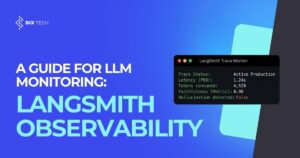
Effective monitoring in LangSmith observability concentrates on three pillars: latency, cost, and quality. Through customized dashboards, teams can identify operational bottlenecks quickly.

  • Latency (P50/P99): Monitors the median and critical cases to identify slow stages, such as re-ranking processes.
  • Cost: Tracks detailed token consumption per endpoint and for each stage of the chain.
  • Customized Vision: Allows for comparing different model versions and usage types, such as chats vs. intelligent searches.

A technical recommendation for LangSmith observability is the use of environment variables to isolate traces of development (Dev) and production (Prod), avoiding the pollution of analytical data.

Mastering LangSmith observability requires total control over critical metrics and the request lifecycle. To help your team monitor these systems efficiently, we have consolidated the most important strategies into a practical material summarized on a single page.

Cost Control and Scale in LangSmith Observability

Scaling LangSmith observability requires strategies to prevent evaluation costs from doubling LLM consumption. The solution is to configure a sampling rate, analyzing only a percentage of messages in production, such as 10%.

Additionally, it is important to monitor platform limits, such as the 5,000 trace ceiling of the free plan. For large-scale projects, LangSmith observability allows exporting data to tools like Grafana or New Relic via Webhooks.

LangSmith observability is what transforms an experimental application into a robust and secure corporate software solution. If you seek to implement this governance in your company, BIX Tech has the expertise to guide your data journey.


Don't miss any of our content

Sign up for our BIX News

Our Social Media

Most Popular

Start your tech project risk-free

AI, Data & Dev teams aligned with your time zone – get a free consultation and pay $0 if you're not satisfied with the first sprint.