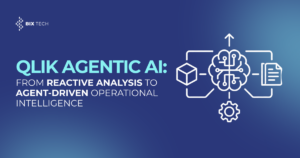
Corporate data analysis is entering a new phase. Instead of dashboard-centric interactions, the experience is now driven by agents capable of investigating changes, connecting evidence, and suggesting actions based on governed data.
This advancement gained momentum with the evolution of the Qlik Agentic AI experience. The public announcement took place at the Qlik Connect 2025 ecosystem, with a private preview in December 2025 and General Availability (GA) in February 2026. The proposal is to transform analytics into a continuous process that integrates data, organizational knowledge, and controlled execution.
This shift is architectural: it changes how data is organized, interpreted, and utilized within the decision-making flow. BIX Tecnologia monitors this movement through the lens of data architecture and analytical governance.

What is Agentic AI and Why This Launch Matters
Agentic AI describes systems that solve analytical problems in multiple steps under governed supervision. In practice, these agents:
- Interpret business objectives.
- Select appropriate data and tools.
- Connect structured and unstructured context.
- Explain results with traceable evidence.
- Suggest next steps aligned with organizational policies.
The focus shifts from showing what happened to explaining what changed, why it changed, and what to do next. This logic brings analytics closer to continuous operational processes.
Core Components of the Presented Architecture
The agent-oriented experience combines layers that operate integrally and depend directly on organized, governed, and semantically consistent data.
Governed Analytical Engine
Responsible for semantic consistency and execution at scale. It includes:
- Standardized and documented metrics.
- Consistently applied business rules.
- Large-scale query and calculation capabilities.
- Traceability of filters, windows, and transformations. This foundation is what enables reproducible and auditable answers.
Integrating Metrics and Knowledge with Qlik Answers
Qlik Answers connects structured data to documents and operational records via Retrieval-Augmented Generation (RAG). In practice, this means:
- Answers that combine numbers and narrative.
- Direct citations from documents and policies.
- Reduction of manual effort to build context.
- Faster validation by technical and executive teams.
Governed Connectivity via Model Context Protocol (MCP)
Integration with external assistants and tools occurs through controlled interfaces. The Model Context Protocol enables:
- Access to analytical capabilities with permission control.
- Interoperability between different assistants.
- Audit trails of queries and actions.
- Reduction of fragile ad-hoc integrations.
Continuous Monitoring with Discovery Agent
The agent layer includes autonomous monitoring of indicators. The Discovery Agent:
- Identifies anomalies and trend shifts.
- Prioritizes relevant signals for investigation.
- Prepares analytical context before human intervention.
- Transforms analytics into a continuous operational flow.
The Main Bottleneck: AI-Ready Corporate Data
The reliability of results depends on the reliability of the data. In real-world environments, the most common blockers are:
- Information silos between systems and departments.
- Divergent definitions of metrics.
- Context scattered across documents and operational records.
- Manual and repetitive analytical flows.
Data prepared for Agentic AI typically features:
- Defined data ownership and contracts.
- Continuously monitored quality.
- Standardized and reusable semantics.
- End-to-end traceable lineage.
- Consistent access controls.
Without these elements, automation simply scales existing inconsistencies.
Quantitative Evidence of Market Movement
Studies conducted by Qlik in partnership with ETR indicate early maturity and a clear strategic direction:
- 97% of organizations have already allocated budget for Agentic AI-related initiatives.
- 46% estimate adoption at scale within 3 to 5 years.
- Approximately 18% report fully operational deployments.
The observed pattern mirrors emerging analytical technologies: high expectations, progressive adoption, and a direct dependency on the data foundation.
Agentic AI Beyond a Single Ecosystem
The convergence of data governance, standardized semantics, and analytical automation is also appearing in other analytics platforms. Market initiatives are advancing in the integration between governed metrics and external assistants.
Differentiation tends to occur in the architecture and ecosystem, rather than in isolated capabilities.
What Changes in Practice for Data-Driven Organizations
Three structural effects tend to emerge:
- Unified Context: Data and organizational knowledge in a single verifiable experience.
- Less Manual Investigative Work: Automation of the steps between the question and the decision.
- Evidence-Based Decisions: Answers accompanied by a reproducible trail.
From an architectural perspective, data maturity becomes an operational prerequisite for AI in production. BIX Tecnologia supports organizations in the structural preparation necessary for safe adoption.
Practical Checklist: Preparing the Environment for Agentic AI
An incremental approach usually accelerates results with lower risk:
- Define a high-value analytical flow with a clear scope.
- Establish governed datasets as the single source of truth.
- Standardize metrics and granularity.
- Implement quality checks and monitoring.
- Ensure an evidence trail in answers.
- Define action and audit policies for agents.
- Execute a pilot with objective acceptance criteria.
- Expand progressively as confidence grows.
If your organization is evaluating how to structure data to support analytical agents, speak with our team.
FAQ: Frequently Asked Questions about Qlik Agentic AI
What differentiates Agentic AI from traditional analytical assistants? It executes complete analytical flows, connects evidence, and suggests actions based on governed data.
Does Qlik Answers replace dashboards? No. It complements analysis by integrating metrics and organizational knowledge into contextualized answers.
What is the role of the Model Context Protocol? To allow governed integration between assistants and corporate data with access control and traceability.
Does the Discovery Agent perform predictions? It automatically identifies patterns and anomalies and prepares analytical context for investigation.
What is the main requirement for adoption? Reliable data, consistent governance, and standardized metrics.