Amazon Web Services (AWS) is the world’s most feature-rich and widely adopted cloud computing platform. It offers more than 200 fully managed services, including computing, storage, databases, analytics, machine learning, Internet of Things (IoT), mobile, security, enterprise applications, and more. These services are delivered from a vast global network of data centers designed to provide high availability, low latency, scalability, and enterprise-grade security.
AWS supports millions of customers worldwide, including startups looking to move fast and stay lean, large enterprises seeking to modernize their IT environments, and public sector organizations working to improve digital infrastructure. The platform enables organizations to reduce capital expenditure, automate infrastructure management, deploy globally in minutes, and accelerate innovation cycles with cloud-native architectures.
Understanding the AWS Global Infrastructure
At the heart of AWS lies its global infrastructure, engineered for resilience, scalability, and low-latency performance. Rather than maintaining physical hardware, customers can provision resources through the AWS Management Console, APIs, or Infrastructure-as-Code tools like AWS CloudFormation and Terraform.

The infrastructure is organized into Regions and Availability Zones. A Region is a distinct geographic area such as US East (N. Virginia), Europe (Frankfurt), or Asia Pacific (Tokyo). Each Region consists of multiple, physically separate and isolated Availability Zones, which are highly secure data centers equipped with independent power, cooling, and networking.
These Availability Zones are interconnected with high-speed, low-latency fiber-optic networking, enabling customers to architect applications that are fault tolerant and highly available. In practice, this means you can replicate applications and databases across zones for disaster recovery, load balancing, and continuous availability.
In addition to Regions and AZs, AWS also leverages a global network of Edge Locations through Amazon CloudFront, its Content Delivery Network (CDN). These Edge Locations bring content closer to end users around the world, enabling faster loading times, improved user experience, and real-time streaming capabilities.
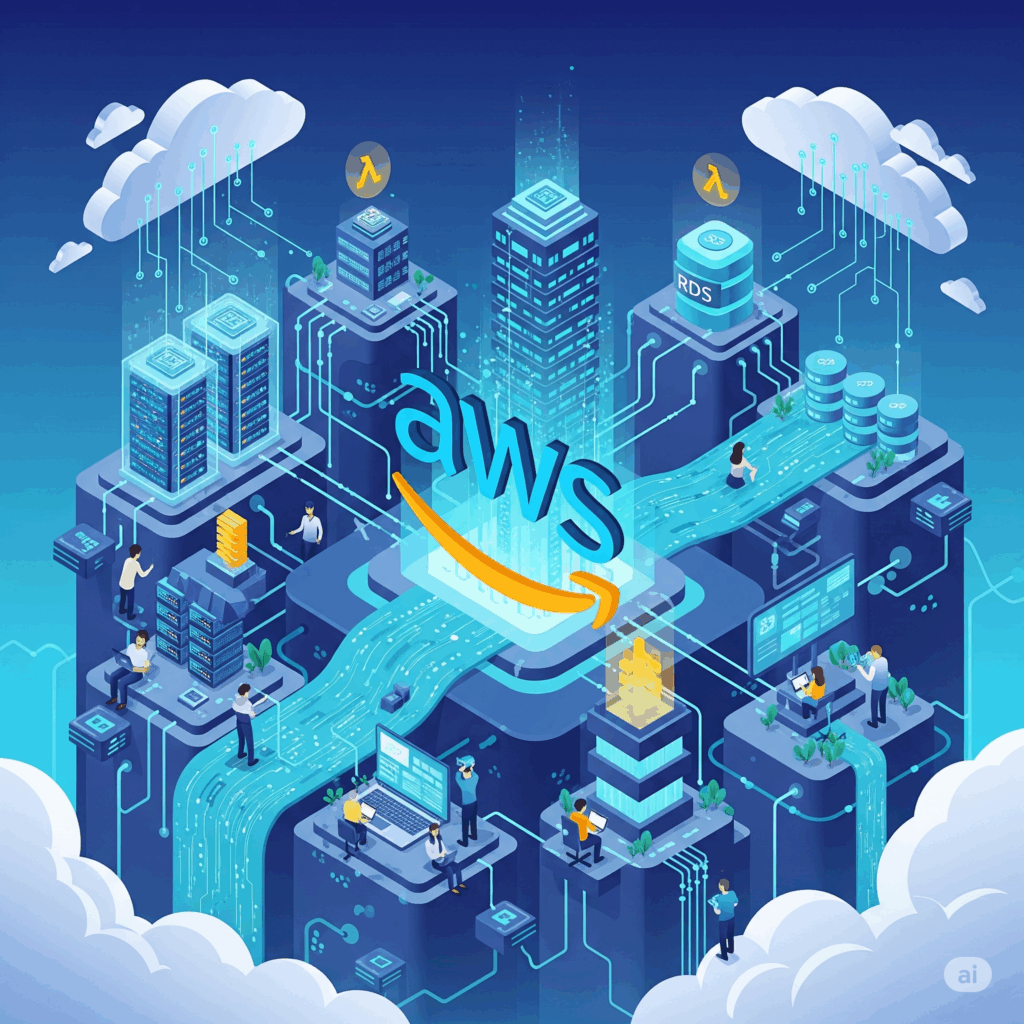
Image made with Gemini.
Core AWS Services: compute, storage, database, serverless, and more
AWS provides an extensive suite of services across multiple domains. Some of the most foundational include:
Amazon EC2 (Elastic Compute Cloud) offers resizable virtual machines, known as instances, which can run operating systems and applications in the cloud. Users can select from a wide variety of instance types optimized for specific use cases, such as general-purpose computing, high-performance workloads, GPU processing, or memory-intensive tasks.
Amazon S3 (Simple Storage Service) is a highly scalable, durable object storage service used for storing files, backups, media content, data lakes, and even hosting static websites. It supports features like lifecycle policies, versioning, replication across regions, and server-side encryption.
Amazon RDS (Relational Database Service) simplifies the provisioning, operation, and scaling of relational databases including MySQL, PostgreSQL, Oracle, SQL Server, and Amazon Aurora. RDS automates tasks such as software patching, backups, and failover, enabling highly available and managed database environments.
AWS Lambda enables serverless computing by allowing developers to run backend functions in response to events without provisioning or managing servers. It automatically scales and is billed per request and execution time, making it ideal for microservices, APIs, and real-time file or data processing.
Other key services include Amazon DynamoDB for fully managed NoSQL databases, Amazon ECS and EKS for container orchestration, AWS Step Functions for workflow automation, and Amazon SageMaker for building, training, and deploying machine learning models at scale.
Pricing flexibility and operational efficiency
AWS’s pricing model is designed to align with operational needs and budget optimization. Instead of large upfront investments, AWS customers benefit from an on-demand pricing model where they pay only for the resources they consume.
Three main pricing options are available:
On-Demand Instances offer flexibility and zero commitment, making them suitable for unpredictable workloads and testing environments.
Reserved Instances provide significant discounts for customers who commit to using specific instance types for one or three years. These are ideal for steady-state workloads.
Spot Instances allow users to purchase spare AWS capacity at significantly reduced prices, well-suited for fault-tolerant and stateless applications like big data processing or machine learning training jobs.
AWS also offers Savings Plans, a flexible pricing model that provides lower prices on usage in exchange for a commitment to a consistent amount of usage (measured in $/hour) for a 1- or 3-year term, across any instance type or region.
Security, compliance, and the shared responsibility model
Security is a fundamental design principle of AWS. It operates under the shared responsibility model, which divides security responsibilities between AWS and the customer.
AWS is responsible for “security of the cloud,” which includes the infrastructure that runs AWS services: hardware, software, networking, and facilities. The customer is responsible for “security in the cloud,” including configurations, data protection, identity and access management, and application-level security.
To help customers meet security and compliance goals, AWS offers tools such as AWS Identity and Access Management (IAM), AWS Key Management Service (KMS), AWS CloudTrail, AWS Shield, AWS WAF, and Amazon GuardDuty.
AWS also adheres to the strictest compliance and certification standards in the industry, including ISO 27001, SOC 1/2/3, PCI-DSS, FedRAMP, HIPAA, GDPR, and others, supporting highly regulated industries like finance, healthcare, and government.
FAQ: Frequently Asked Questions about AWS
1. What can I build or run using AWS?
AWS supports a vast range of use cases including website hosting, backend services, AI/ML pipelines, mobile applications, game servers, big data processing, IoT platforms, enterprise applications, and much more.
2. How do AWS Regions and Availability Zones ensure high availability?
Regions are isolated for compliance and fault tolerance, while Availability Zones within each Region are connected by low-latency networks. Deploying across multiple AZs allows applications to continue functioning even if one AZ becomes unavailable.
3. What is the main benefit of using AWS Lambda over EC2?
Lambda is serverless, meaning you don’t have to manage infrastructure or pay for idle compute time. It’s perfect for event-driven functions, microservices, and real-time processing, while EC2 provides full control over the operating system and environment.
4. How do I control costs on AWS?
Use AWS Budgets, Cost Explorer, and Trusted Advisor to monitor and forecast spending. Select the appropriate pricing model (On-Demand, Reserved, or Spot) and consider Savings Plans to reduce long-term expenses.
5. Is AWS only for large enterprises?
No. AWS is designed to be accessible to startups, small businesses, educational institutions, and independent developers. It offers free-tier services, grants, and startup programs like AWS Activate to support early-stage innovation.
6. What programming languages can I use on AWS?
You can use nearly all major programming languages, including Python, Java, Node.js, Go, C#, Ruby, and PHP. AWS SDKs and APIs support seamless integration with a wide range of languages and frameworks.
7. What tools does AWS provide for DevOps and automation?
AWS offers services like AWS CodePipeline, CodeDeploy, CodeBuild, CloudFormation, and AWS CLI for CI/CD pipelines, infrastructure as code, and automated deployments.
8. How does AWS help with regulatory compliance?
AWS provides built-in compliance controls, audit logging, encryption services, and access management features to help customers meet requirements for GDPR, HIPAA, PCI-DSS, ISO certifications, and more.
9. Can I host a database in AWS?
Yes. AWS offers fully managed services for both relational (RDS, Aurora) and non-relational (DynamoDB, DocumentDB) databases with automated backups, scaling, monitoring, and high availability options.
10. How does AWS ensure data security and privacy?
AWS encrypts data in transit and at rest using industry-standard algorithms. You can manage your own keys through AWS KMS, implement fine-grained access controls using IAM, and audit activity with CloudTrail.
Build the future of your business with us
At BIX Tech, we specialize in data-driven solutions and artificial intelligence, powered by scalable and secure cloud infrastructure. We help companies of all sizes accelerate their digital transformation by designing and delivering tailored projects using the best of AWS technology. If you’re ready to bring your ideas to life or enhance your systems with high-performance cloud solutions, click the banner below and start building with us.